






 Spell
 Continuous
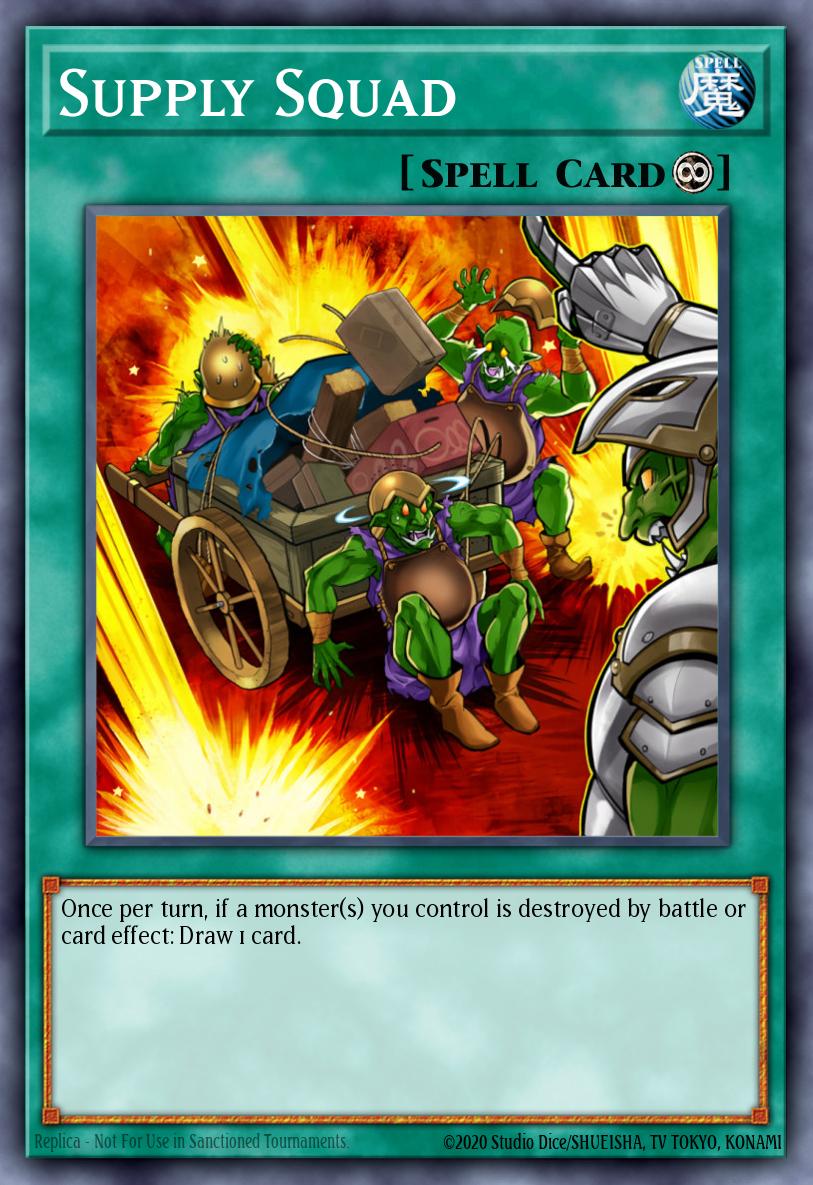
Supply Squad
View:
3677
Once per turn, if a monster(s) you control is destroyed by battle or card effect: Draw 1 card.
Supply Squad — Power Evaluation
Final Score: 50 ± 8 · Confidence: Medium
- Intrinsic: 51 · Deck: 50 · Meta: provisional
- Primary role: Utility · Secondary: Recovery/Recursion
Why it scores here
Supply Squad turns a monster being destroyed by battle or card effect into one card, once per turn, so its value depends on destruction actually happening and is never guaranteed. Its 287-deck footprint across 84 archetypes shows it is a generic, portable card-advantage staple, but that frequency only confirms accessibility and does not raise the score on its own (guardrail 3). With no combo, searcher, or guide evidence, the card stays in the middle band and nothing in the evidence pushes it higher.
Axis scores
| Axis | Score | Evidence |
|---|---|---|
| Accessibility | 50 | A Continuous Spell that must be drawn or otherwise reached; no searcher or starter data is supplied, but 287 decks at 1.56 average copies show it is routinely live (observed). |
| Combo & Conversion | 35 | Passive trigger that converts destruction into a single draw with no board or combo output; combo data is empty, so this rests on the card text (inferred). |
| Resource Economy | 60 | Repeated +1 card per turn with no cost, but gated on destruction and capped at once per turn (verified from text). |
| Effect & Interaction | 15 | No negation, removal, or hand-trap reach; the card only draws (verified from text). |
| Material Utility | 10 | A Spell card, so it provides no material, level, attribute, or name value (verified from text). |
| Resilience & Flexibility | 45 | Sits face-up on the field and can be removed by backrow or Continuous Spell answers, but its once-per-turn draw can recur over multiple turns while the field is live (inferred). |
| Deck-Building Efficiency | 80 | Low-cost copies (1 to 3 per deck), no garnet or lock, and it is easy to slot into many shells (observed). |
Calculation
Weight profile: 0.7 Utility + 0.3 Recovery/Recursion. Intrinsic ≈ 51, Deck ≈ 50, Meta = provisional. Modifiers: none. Final formula: 0.40*Intrinsic + 0.60*Deck
Strengths
- Generic, portable card advantage that fits across 84 archetypes
- Costless once-per-turn draw with no garnet or lock cost
- Redundant across many decks, so the line survives losing one copy
Weaknesses
- Draw is conditional on a monster being destroyed, so it can be dead in quiet turns
- No interaction, negation, or removal
- Continuous Spell with no recursion, so backrow removal ends it
Counters / choke points
- Backrow removal or Continuous Spell destruction
- Decks that avoid destruction-based play or keep monsters on the field
Best use
Utility card-advantage engine that adds a draw when monsters trade or die. Decks: Machina, Egyptian God, Fire King, Crystron, Exodia, Unchained, Scrap, Red-Eyes, Graydle.
Evidence & gaps
- Verified: Once per turn, draws 1 card when a monster you control is destroyed by battle or card effect (card text); Spell card, Continuous, 3 legal formats (card data); 287 recent decks, 84 distinct archetypes, average 1.56 copies (deck data)
- Observed: Runs in 287 recent decks, 82.9% in gameplay type 7 (deck data); Top partners include Harpie's Feather Duster and Monster Reborn, both generic staples (deck data)
- Inferred: Acts as a resource engine that is only live when destruction occurs (inferred from text); Vulnerable to Continuous Spell or backrow removal (inferred from card type)
- Data gaps: No combos supplied, so combo conversion is text-only inference No guides supplied No banlist token; assumed 3 copies (unlimited) No usage statistics beyond two archetypes, so inclusion breadth is only partly calibrated